

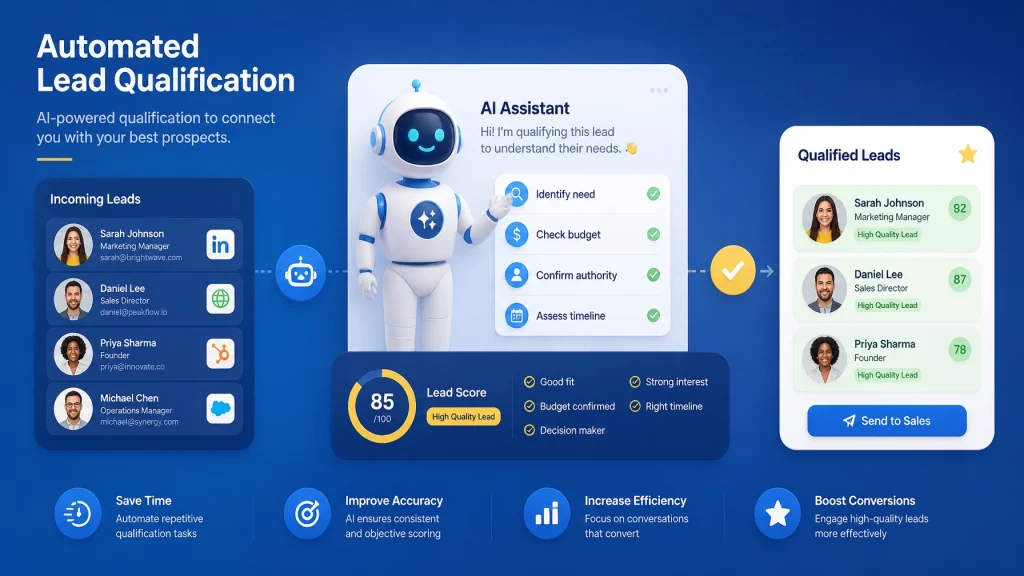
5 Steps to Automate Your Lead Qualification Pipeline (Without Sounding Like a Robot)

06.08.2026

In today’s hyper-connected digital landscape, speed is everything. When a prospective client reaches out, expecting an instant answer while evaluating your services, a delay of even a few minutes can mean losing them to a competitor. Yet, scaling your intake and qualification process has traditionally meant sacrificing the personal touch: forcing businesses to choose between cumbersome manual screening and rigid, frustrating automated phone trees that alienate potential buyers.

Enter modern conversational AI. Far from the clunky, robotic IVR systems of the past, today’s intelligent AI Receptionist and automated agents engage prospects in natural, fluid dialogues. They listen, understand context, and qualify leads around the clock without ever sounding scripted.

In this comprehensive guide, we explore a proven 5-step framework to automate your lead qualification pipeline while preserving the warmth, empathy, and authenticity that build lasting client relationships.


1. Map Your Ideal Customer Profile (ICP) and Core Qualification Criteria

Before introducing any automation into your sales funnel, you must define precisely what makes a high-value lead for your business. Too many organizations automate lead routing before clarifying their core criteria, resulting in pipelines clogged with unqualified inquiries.

To establish your foundational rules, sit down with your sales team and answer key qualifying questions:

  • What are the definitive budget thresholds for your services?
  • What specific timeline or urgency markers indicate a sales-ready prospect?
  • Which industry verticals or operational pain points represent your highest-converting opportunities?

By codifying these parameters, you give your intelligent AI Customer Service Agent the exact benchmarks it needs to evaluate incoming prospects accurately. Whether you operate in tradies, real estate, healthcare, or professional services, clarity at this initial stage ensures that downstream automation focuses only on high-value revenue drivers.


2. Set Up Conversational Qualification Flows

The biggest mistake businesses make when adopting lead qualification automation is relying on rigid, multiple-choice phone prompts or unnatural text scripts. Prospects instantly recognize when they are talking to a box, and friction increases immediately.

Modern conversational AI transforms this dynamic. Instead of forcing callers down a narrow questionnaire, natural language processing (NLP) allows AI agents to converse dynamically, adapting their phrasing based on how the prospect responds.

Conversational Qualification Flow

How to design human-centric flows:

  • Adopt open-ended discovery: Allow prospects to describe their project or problem in their own words rather than choosing from generic menu numbers.
  • Inject empathetic acknowledgement: Program your conversational flow to validate customer concerns (e.g., "That sounds like a stressful plumbing emergency; let's get someone scheduled to help you right away").
  • Keep conversational turns concise: Ask one qualifying question at a time to maintain a natural dialogue rhythm rather than interrogating the prospect all at once.

When your system speaks naturally, callers feel heard and respected from the very first interaction.


3. Automate Lead Scoring and Intelligent Routing

Once an inquiry is captured and conversational data is gathered, your pipeline needs to categorize and score the lead instantly. Manual lead scoring often introduces bottlenecks where hot prospects sit unassigned in an inbox while administrative staff catch up.

An automated scoring framework evaluates the conversational output against your ICP criteria in real time. High-intent leads exhibiting urgent timelines, appropriate budgets, and clear decision-making authority are instantly flagged and assigned top priority. Meanwhile, exploratory or lower-tier inquiries can be nurtured through automated educational sequences or routed to secondary support channels.

This systematic triage ensures your internal team spends their valuable hours exclusively on prospects who are ready to convert, drastically shortening your sales cycle and maximizing return on investment.


4. Integrate Your Calendar for Instant Booking

Qualification loses half its value if the prospect is told, "Thanks, someone will call you back in 24 to 48 hours." By the time a human calls back, the prospect has often moved on or lost momentum.

Closing the loop requires instant, frictionless appointment setting. By integrating your scheduling tools directly with your conversational qualification engine, qualified leads can secure a consultation or on-site quote while they are still on the phone or active in chat.

Calendar Integration and Instant Booking

Key implementation practices for automated booking:

  • Sync real-time availability: Ensure your AI agent accesses live calendar slots to prevent double-booking.
  • Confirm details instantly: Have the system automatically dispatch SMS and email confirmations with calendar invites and preparation notes.
  • Reduce no-shows: Program automated reminder sequences 24 hours and 2 hours prior to the scheduled appointment.

This seamless transition from qualification to calendar booking turns casual interest into confirmed revenue without manual administrative overhead.


5. Follow Up Automatically Without Scripts

Lead nurturing is where most sales pipelines break down. Sales professionals get busy with active jobs, client deliverables, or field work, and follow-up emails or proposal reminders fall through the cracks.

Automating follow-up does not mean bombarding prospects with generic, robotic marketing blasts. Intelligent automation tracks engagement with proposals, estimates, and inquiries, deploying timely, context-aware follow-ups that feel genuinely personal.

Automated Follow-up Workflow

Effective automated follow-up strategies include:

  • Proposal check-ins: Automatically following up three days after a proposal is sent to ask if the client has questions about the scope.
  • Unresponsive lead re-engagement: Gently checking in after a brief period of silence without sounding pushy or automated.
  • Post-service feedback collection: Automatically gathering reviews and referrals once a project is marked complete.

By maintaining consistent, tailored communication behind the scenes, your business stays top-of-mind without requiring constant manual oversight.


Conclusion

Automating your lead qualification pipeline is no longer reserved for large enterprises with massive IT budgets. Modern business automation empowers growing businesses in high-call industries to capture every opportunity, qualify prospects accurately, and book appointments 24/7: all while maintaining a warm, human-centric tone that builds instant trust.

By mapping your ideal customer profile, deploying natural conversational flows, automating lead scoring, integrating instant calendar booking, and maintaining intelligent follow-up, you can scale your operations efficiently and never miss another valuable lead.

Ready to transform your lead qualification process with natural, human-sounding AI agents? Contact Us today to discover how AI Connect Pro can custom-build your automated growth engine.
more insights

5 Steps to Automate Your Lead Qualification Pipeline (Without Sounding Like a Robot)

06.08.2026 In today’s hyper-connected digital landscape, speed is everything. When a prospective client reaches out, expecting an instant answer while evaluating your services, a delay of even a few minutes can mean losing them to a competitor. Yet, scaling your intake and qualification process has traditionally meant sacrificing the personal touch: forcing businesses to choose between cumbersome manual screening and rigid, frustrating automated phone trees that alienate potential buyers. Enter modern conversational AI. Far from the clunky, robotic IVR systems of the past, today’s intelligent AI Receptionist and automated agents engage prospects in natural, fluid dialogues. They listen, understand context, and qualify leads around the clock without ever sounding scripted. In this comprehensive guide, we explore a proven 5-step framework to automate your lead qualification pipeline while preserving the warmth, empathy, and authenticity that build lasting client relationships. 1. Map Your Ideal Customer Profile (ICP) and Core Qualification Criteria Before introducing any automation into your sales funnel, you must define precisely what makes a high-value lead for your business. Too many organizations automate lead routing before clarifying their core criteria, resulting in pipelines clogged with unqualified inquiries. To establish your foundational rules, sit down with your sales team and answer key qualifying questions: What are the definitive budget thresholds for your services? What specific timeline or urgency markers indicate a sales-ready prospect? Which industry verticals or operational pain points represent your highest-converting opportunities? By codifying these parameters, you give your intelligent AI Customer Service Agent the exact benchmarks it needs to evaluate incoming prospects accurately. Whether you operate in tradies, real estate, healthcare, or professional services, clarity at this initial stage ensures that downstream automation focuses only on high-value revenue drivers. 2. Set Up Conversational Qualification Flows The biggest mistake businesses make when adopting lead qualification automation is relying on rigid, multiple-choice phone prompts or unnatural text scripts. Prospects instantly recognize when they are talking to a box, and friction increases immediately. Modern conversational AI transforms this dynamic. Instead of forcing callers down a narrow questionnaire, natural language processing (NLP) allows AI agents to converse dynamically, adapting their phrasing based on how the prospect responds. How to design human-centric flows: Adopt open-ended discovery: Allow prospects to describe their project or problem in their own words rather than choosing from generic menu numbers. Inject empathetic acknowledgement: Program your conversational flow to validate customer concerns (e.g., "That sounds like a stressful plumbing emergency; let's get someone scheduled to help you right away"). Keep conversational turns concise: Ask one qualifying question at a time to maintain a natural dialogue rhythm rather than interrogating the prospect all at once. When your system speaks naturally, callers feel heard and respected from the very first interaction. 3. Automate Lead Scoring and Intelligent Routing Once an inquiry is captured and conversational data is gathered, your pipeline needs to categorize and score the lead instantly. Manual lead scoring often introduces bottlenecks where hot prospects sit unassigned in an inbox while administrative staff catch up. An automated scoring framework evaluates the conversational output against your ICP criteria in real time. High-intent leads exhibiting urgent timelines, appropriate budgets, and clear decision-making authority are instantly flagged and assigned top priority. Meanwhile, exploratory or lower-tier inquiries can be nurtured through automated educational sequences or routed to secondary support channels. This systematic triage ensures your internal team spends their valuable hours exclusively on prospects who are ready to convert, drastically shortening your sales cycle and maximizing return on investment. 4. Integrate Your Calendar for Instant Booking Qualification loses half its value if the prospect is told, "Thanks, someone will call you back in 24 to 48 hours." By the time a human calls back, the prospect has often moved on or lost momentum. Closing the loop requires instant, frictionless appointment setting. By integrating your scheduling tools directly with your conversational qualification engine, qualified leads can secure a consultation or on-site quote while they are still on the phone or active in chat. Key implementation practices for automated booking: Sync real-time availability: Ensure your AI agent accesses live calendar slots to prevent double-booking. Confirm details instantly: Have the system automatically dispatch SMS and email confirmations with calendar invites and preparation notes. Reduce no-shows: Program automated reminder sequences 24 hours and 2 hours prior to the scheduled appointment. This seamless transition from qualification to calendar booking turns casual interest into confirmed revenue without manual administrative overhead. 5. Follow Up Automatically Without Scripts Lead nurturing is where most sales pipelines break down. Sales professionals get busy with active jobs, client deliverables, or field work, and follow-up emails or proposal reminders fall through the cracks. Automating follow-up does not mean bombarding prospects with generic, robotic marketing blasts. Intelligent automation tracks engagement with proposals, estimates, and inquiries, deploying timely, context-aware follow-ups that feel genuinely personal. Effective automated follow-up strategies include: Proposal check-ins: Automatically following up three days after a proposal is sent to ask if the client has questions about the scope. Unresponsive lead re-engagement: Gently checking in after a brief period of silence without sounding pushy or automated. Post-service feedback collection: Automatically gathering reviews and referrals once a project is marked complete. By maintaining consistent, tailored communication behind the scenes, your business stays top-of-mind without requiring constant manual oversight. Conclusion Automating your lead qualification pipeline is no longer reserved for large enterprises with massive IT budgets. Modern business automation empowers growing businesses in high-call industries to capture every opportunity, qualify prospects accurately, and book appointments 24/7: all while maintaining a warm, human-centric tone that builds instant trust. By mapping your ideal customer profile, deploying natural conversational flows, automating lead scoring, integrating instant calendar booking, and maintaining intelligent follow-up, you can scale your operations efficiently and never miss another valuable lead. Ready to transform your lead qualification process with natural, human-sounding AI agents? Contact Us today to discover how AI Connect Pro can custom-build your automated growth engine.
Read more >

AI Receptionist vs Virtual Receptionist for Tradies: Which One Actually Books More Jobs?

06.08.2026 For plumbers, electricians, builders, and specialist contractors, every missed phone call represents a potential job handed directly to a competitor. When you are under a kitchen sink, up a ladder, or wiring a switchboard, answering the phone is simply impossible. To solve this bottleneck, modern contractors turn to remote support. But when choosing between an automated system and a human-powered remote service, which option truly maximises revenue? This in-depth comparison evaluates the strengths, costs, and operational realities of each approach so your contracting business can capture every profitable lead. Understanding the Modern Tradie Communication Challenge In the contracting industry, speed-to-lead is everything. Studies consistently show that customers inquiring about urgent repairs or upcoming installations will hang up and dial the next business on Google if their call goes unanswered within seconds. Traditional voicemail is where leads go to die; very few homeowners leave detailed messages when they need immediate help. Business owners often attempt to manage this by juggling mobile phones on site, hiring part-time staff, or engaging human call centres. However, rising labour costs and the sheer volume of after-hours enquiries make these manual methods increasingly unsustainable. This is why implementing a reliable AI answering service for small business operations has shifted from a futuristic luxury to an absolute necessity for competitive trades. How to Evaluate Your Current Lead Capture Efficiency Before investing in any reception solution, conducting an internal audit of your current call handling is essential. Follow these steps to measure your gaps: Track Missed Calls: Review your phone carrier logs for the past thirty days to count how many inbound calls went to voicemail during peak working hours and after 5 PM. Calculate Lost Job Value: Multiply your average job value by your estimated missed call rate. Even losing two jobs a week translates to tens of thousands in unrealized annual revenue. Measure Follow-up Speed: Assess how quickly enquiries from web forms or voicemails receive a callback. Delays beyond fifteen minutes dramatically reduce conversion rates. Identify Peak Inflow Times: Determine whether your missed calls cluster around early mornings, evenings, or weekends when your team is off the tools. AI Receptionist vs Virtual Receptionist: A Direct Comparison for Tradies To help you determine which system fits your operational model, the following table breaks down how AI receptionists and human virtual receptionists stack up across key categories relevant to tradies. Feature / Metric AI Receptionist Virtual Receptionist (Human) Availability 24/7/365 instant availability with zero downtime, breaks, or sick leave. Typically restricted to standard business hours; 24/7 coverage incurs steep surcharges. Cost Structure Predictable flat monthly subscription (significantly lower ongoing overhead). Per-minute or per-call billing that scales rapidly with high call volumes. Simultaneous Calls Handles unlimited concurrent callers instantly; zero wait times or busy signals. Limited to one caller per agent; callers experience hold music or overflow during surges. System Integration Connects directly with job management software for automated scheduling and instant SMS follow-up. Varies by provider; often requires manual data entry or basic calendar links. Empathy & Judgment Consistent, rule-based execution optimized for standard bookings and FAQs. High human empathy, ideal for de-escalating highly emotional or distressed callers. Consistency Follows customized scripts and qualification workflows flawlessly every single time. Subject to human fatigue, mood variations, and inconsistent script adherence. Main Features of an AI Answering Service for Small Business Modern artificial intelligence platforms built for trade businesses offer robust capabilities that go far beyond basic message-taking. Tailored tools like our specialized AI Receptionist solution deliver several core advantages: Instant Multi-Call Handling: Unlike a single human agent who can only speak to one person at a time, an AI system answers multiple incoming calls simultaneously so no customer ever encounters a busy tone. Automated Job Qualification: The system asks critical scoping questions: such as job scope, location, and urgency: ensuring you only spend time quoting qualified prospects. Seamless Calendar Booking: Verified appointments are booked directly into your scheduling software and confirmed automatically via SMS and email. Intelligent After-Hours Routing: Routine quote requests are safely captured overnight, while genuine emergency repair calls can be immediately forwarded to an on-call technician. Overcoming the #1 Fear: Does AI Sound Robotic? The single most common hesitation business owners express when exploring automation is the fear that callers will immediately realize they are speaking to a machine and hang up. Early automated phone trees of the past left a lasting impression of clunky, frustrating robotic menus. However, enterprise-grade systems have evolved dramatically. At AI Connect Pro, our core USP centres on advanced natural language processing that delivers fluid, natural, human-sounding conversations rather than rigid, robotic scripts. Callers engage in a smooth, polite dialogue, answering questions about their plumbing or electrical needs naturally without feeling rushed or boxed into rigid numeric menu choices. This creates an approachable, professional first impression that builds immediate trust in your brand. How AI for Tradies Lead Capture Transforms Your Pipeline Implementing structured AI for tradies lead capture fundamentally changes how your business operates day-to-day. When you integrate intelligent agents specifically designed for trade workflows: such as our dedicated AI Tradies framework: you eliminate administrative friction across the entire customer journey. Instead of returning home exhausted from a full day on site only to face a backlog of missed voicemails and unanswered text messages, your pipeline stays active around the clock. Leads are qualified, appointments are booked, and proposals or invoices receive automated follow-ups without requiring manual intervention from you or your office staff. This operational efficiency allows you to focus purely on delivering exceptional craftsmanship on the job. Conclusion Choosing between an AI receptionist and a human virtual receptionist comes down to your budget, call volume, and business goals. While human receptionists offer valuable emotional nuance for highly complex complaints, they remain costly and difficult to scale 24/7. For most plumbing, electrical, and construction businesses, an AI receptionist delivers the ideal balance of instant availability, flawless consistency, and massive cost savings. By capturing every lead the moment it arrives and booking jobs automatically, intelligent automation ensures your

Read more >

Missed 5 Calls Today? Here’s What That Really Cost Your Business (2026 Calculator Inside)

06.08.2026 Every missed phone call feels like a minor inconvenience in the middle of a busy workday: until you calculate the financial hemorrhage. In 2026, small and mid-sized businesses are losing hundreds of thousands of dollars annually simply because the phone keeps ringing without an answer. Whether you operate a bustling trade business, manage high-stakes real estate transactions, or run a medical clinic, every unanswered ring represents a warm lead walking straight to your competitor. This deep dive examines the hard 2026 economic data behind missed calls across key service industries and introduces a powerful ROI calculator framework: powered by an intelligent AI answering service for small business: to plug the leaks in your revenue pipeline. The 2026 Economic Reality of Unanswered Calls The modern consumer expects instant gratification. When a customer dials a local contractor, a real estate agent, or a healthcare provider, they rarely leave voicemails. Instead, they hang up and dial the next number on Google search results. Recent economic analyses for 2026 reveal staggering figures: Average Small Business Loss: Studies estimate that small service businesses lose upwards of $126,000 per year due to missed calls alone. Direct Per-Call Cost: Depending on the sector, an immediate missed call costs between $12 and $350 in direct revenue, before accounting for customer lifetime value and repeat referrals. Miss Rates: Industry benchmarks indicate that 28% to 62% of inbound calls to small businesses go completely unanswered during peak hours and after-hours. Relying on traditional voicemail or an overworked front desk staff is no longer viable in a 24/7 digital economy. Implementing advanced AI lead generation software ensures that every single inbound inquiry is captured, qualified, and converted instantly. How to Calculate Your True Cost: The 2026 ROI Calculator Framework To understand how much revenue is slipping through your fingers, you need a structured formula. Here is the exact framework businesses use to audit their missed call losses and calculate the return on investment (ROI) of automated lead capture. Total Annual Loss = (Missed Calls Per Day) × (Working Days Per Year) × (Close Rate) × (Average Job/Customer Value) Step 1: Track Your Daily Missed Volume Review your phone logs for the past week. Count how many calls went to voicemail or disconnected without speaking to a human. For most small businesses, averaging 5 missed calls a day is conservative. Over 250 working days, that totals 1,250 missed opportunities every single year. Step 2: Apply Your Industry Conversion and Job Value Benchmarks Different sectors experience vastly different financial impacts due to varying job ticket sizes and closing rates. 1. Tradies & Home Services (HVAC, Plumbing, Electrical) Missed Call Rate: 27% to 62% (some contractors hit 74% during peak job execution). Average Job Value: $275 to $1,200+ (with high-ticket HVAC installations exceeding $3,500). Annual Revenue at Risk: Tradies routinely lose $75,000 to $250,000 per year because technicians are on-site with tools in hand, unable to answer the phone. Utilizing a dedicated AI solution for home services captures every urgent repair call instantly. 2. Real Estate Agencies Missed Call Rate: Up to 40% for new buyer inquiries during peak listing seasons. Average Commission Value: $3,000 to $9,000+ per closed transaction. Annual Revenue at Risk: Real estate professionals face staggering stakes. A single missed buyer call can equal a lost commission of $100,000 to $820,000+ in property transaction volume annually. Partnering with a specialized real estate AI agent guarantees that property inquiries are qualified and booked within seconds. 3. Healthcare Practices (Medical & Dental Clinics) Missed Call Rate: ~29% to 32% during clinic hours, spiking to 71% after hours. Average Patient Value: $100 to $285 per standard visit, and thousands for specialized treatments. Annual Revenue at Risk: Medical and dental practices lose $50,000 to $375,000 per year in missed appointments and consultations. Implementing a secure, tailored solution like our AI Health Care platform ensures patient calls, appointment bookings, and reminder workflows run seamlessly 24/7. Main Features: How Intelligent AI Agents Stop the Leakage Stopping revenue leakage requires more than a basic answering machine. Modern businesses leverage sophisticated AI workflows designed around specific operational goals. Here are the core features that transform missed calls into confirmed pipeline revenue: 1. 24/7 Instant Voice Answering Every call is answered on the very first ring with natural, human-sounding conversation: eliminating robotic phone trees that frustrate callers. Your business is always open, even at midnight on a Sunday. 2. Automated Lead Qualification & CRM Sync The AI agent conducts dynamic conversations to understand the caller's needs, budget, urgency, and project scope. Qualified leads are instantly categorized and synchronized into your CRM. 3. Frictionless Appointment Booking Rather than playing phone tag, the AI checks your live calendar, suggests optimal slots, books the appointment, and sends instant SMS and email confirmations: completely hands-free. 4. Continuous Workflow Optimization Advanced analytics track conversion bottlenecks, call sentiment, and follow-up success rates, allowing businesses to continuously optimize their customer acquisition pipeline. How to Implement an AI Answering Solution in 3 Simple Steps Transitioning from manual call handling to automated lead capture is straightforward when following a structured deployment roadmap: Audit Your Inbound Flow: Review your current phone logs to identify peak missed-call hours and estimate your average monthly lead volume. Design Custom AI Workflows: Map out your ideal customer journey: from initial greeting and qualification criteria to calendar booking rules. Deploy and Scale: Integrate the AI receptionist with your existing phone numbers and CRM software, then let it handle incoming traffic while your team focuses on closing deals. Conclusion Missing 5 calls today is not just a minor scheduling glitch: it is a direct drain on your bottom line, costing service businesses between $50,000 and $250,000+ every single year. In 2026, consumer patience has evaporated, and responsiveness dictates market share. By deploying intelligent AI solutions tailored for tradies, real estate professionals, and healthcare providers, you ensure that every single ring turns into a captured opportunity. Explore our AI Receptionist services today and discover how effortless 24/7 lead conversion can be.

Read more >